
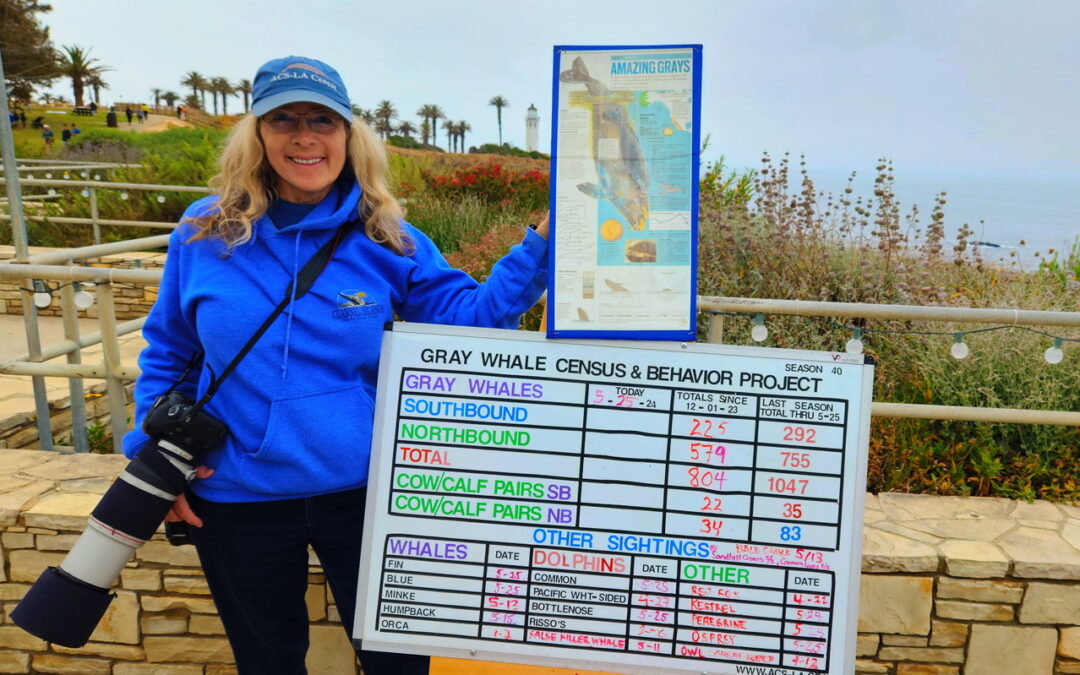
Photo of Alisa Schulman-Janiger at our Gray Whale Census location on the bluffs behind the Palos Verdes Interpretive Center. Photo by Dave Janiger.
ACS/LA Gray Whale Census and Behavior Project, 2023-2024 Update: we documented very low gray whale counts, few calves, late southbound migration, and early northbound migration – but also fewer skinny whales, and many other marine mammal species seen! This was the 40th season that the American Cetacean Society’s Los Angeles Chapter sponsored a full season gray whale census project from the Palos Verdes Peninsula, continuing our long-term monitoring of nearshore gray whales; most grays choose offshore routes here. Our cliff side post is on the Point Vicente Interpretive Center (PVIC) patio, 137 feet above kelp beds and rocky shoreline; sea floor drops off abruptly near shore. Trained volunteers (citizen scientists) collect data on gray whales and other cetaceans, including identifications, counts, and behaviors. All participants use binoculars with reticles and compass; several use spotting scopes to confirm and detail sightings. Weather data (visibility, weather conditions, and sea conditions) is recorded twice hourly. For the second season in a row, we set a new record low southbound gray whale count, and our second lowest northbound gray whale count. We spotted fewer gray whale calves, ending up with our 18th lowest southbound calf count and 8th lowest northbound calf count. We documented a (2 week) later southbound migration and a (3 week) earlier northbound migration – perhaps to prolong foraging time in northern feeding areas. Our Gray Whale Census operated on 170 days, between 1 Dec 2023 – 25 May 2024. We closed down on 7 days due to heavy rains, mudslides, closed roads, and/or very high winds! Teams of observers were on duty for 1,990 hours over 170 days, averaging ~11.7 hours/day; 98 volunteers contributed 8,687 effort hours. Experienced observers anchor all shifts: 34 core volunteers each contributed over 100 hours (totaling 65.8% of our effort hours). We counted 225 southbound gray whales, including 22 newborn calves (9.8% of southbound migrants); previous seasons’ southbound counts have varied from 293-1902. We also counted 579 northbound gray whales, including 34 calves (5.9% of northbound migrants); previous seasons’ northbound counts have varied from 521-3,412. Our northbound gray whale migration started and ended much earlier than last season; we only spotted four northbound grays (and NO calves) in May! Frustratingly, we spotted NO gray whales on 51/170 days, both early and late in our season; many of those null days occurred in excellent sighting conditions. We spotted many other marine mammal species, including common dolphins, coastal and offshore bottlenose dolphins, Pacific white-sided dolphins, Risso’s dolphins, false killer whales, killer whales, a blue whale (on our last day!), fin whales, humpback whales, minke whales, sei or Bryde’s whales (for the first time), California sea lions, and harbor seals.
There were fewer reported strandings and skinny grays this past year, good news that led NOAA Fisheries to close the 2019-2023 Gray Whale Unusual Mortality Event (UME) in November 2023. NOAA Fisheries’ Eastern North Pacific gray whale population estimates plummeted from ~27,000 (early 2016) to ~13,230-15,960 (early 2023), then rose to ~17,400-21,300 (early 2024). A large percentage of 2019 UME mortalities were adult females, further depressing subsequent birth rates. An uptick in gray whale calf counts last season may have resulted in more adult females taking a “resting” year between calves; this might help explain lower calf counts this season along our coast and in Baja CA nursery lagoons.
Summary by Alisa Schulman-Janiger