ACS-LA Across the Internet
Events
Make a donation
Current Cetacean News
Our ACS-LA Board posts current cetacean news on our Facebook page and the most recent articles can be found on this page. Keep up-to-date by coming back often! And if you are on Facebook, follow us!


American Cetacean Society - Los Angeles Chapter (ACS/LA)
(opens in a new tab)Founded in 1967, the American Cetacean Society protects whales, dolphins, porpoises, and their habitats through public education, research grants, and conservation actions.
No upcoming events
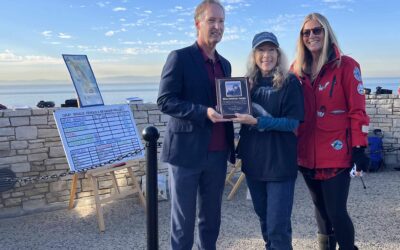
Commemorating 40 Years, Gray Whale Census
On Dec. 1st, 2024, Alisa Schulman-Janiger was recognized for her 40 years of dedication as Director and Coordinator of ACS-LA’s Gray Whale Census and Behavior Project by the Mayor of Rancho Palos Verdes, John Cruikshank. The ACS-LA Board was joined by Census citizen...
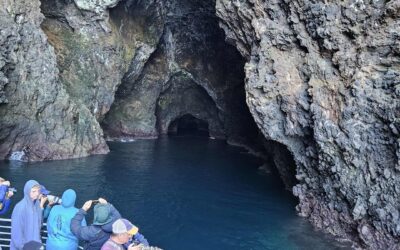
2025 Annual Summertime 8 hour whale watch on the Condor Express
Painted Cave, Santa Cruz Island
Photo credit: Patty Farrell
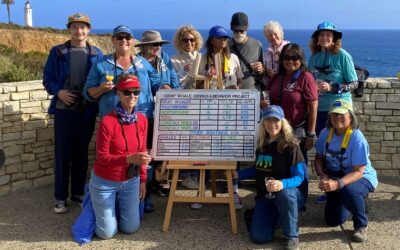
2024-2025 Gray Whale Census Summary
Gray Whale Census Team with our whiteboard displaying our final counts for this season. Clockwise, L to R: Joyce Daniels, Ben Tyrrell, Terri Bidle, Gerrie Teague Cole, Carla Krysiak, Iva Maes, Gregg Gentry, Stacey Patterson, Erlinda Cortez, Kim Hoch, Cynthia Woo, and...
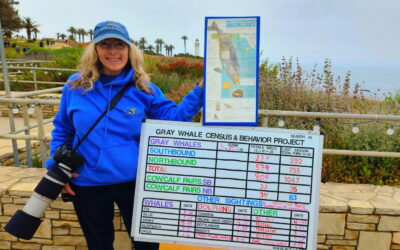
2023-2024 Gray Whale Census Summary
Photo of Alisa Schulman-Janiger at our Gray Whale Census location on the bluffs behind the Palos Verdes Interpretive Center. Photo by Dave Janiger. ACS/LA Gray Whale Census and Behavior Project, 2023-2024 Update: we documented very low gray whale counts, few...
Our Partners and Sponsors





💕💕More Eastern Tropical Pacific (ETP) orcas off San Diego today: different pod (not the other two pods seen in the past week); the orca count was estimated at 15-20, and later likely 30+, according to Domenic Biagini of Gone Whale Watching San Diego! They quickly killed a young fin whale this morning; different ETPs killed a larger fin whale off San Diego on Oct 17! Today's group included an older adult male who is over 60 years old! He has several catalog numbers, including ME87, from our "Killer Whales of California and Western Mexico: A Catalog of Photo-Identified Individuals" ((N. Black, A. Schulman-Janiger, R. Ternullo, and M. Guerrero, 1997). He is also known as E256, 533-D-Oo-UABCS, and MX87; his nickname is Cuitláhuac". He was first documented in May 1984 as an adult male; since male dorsal fins do not reach adult height until they are about 20 years, he is definitely over 60 now - quite old for an adult male! Bob Pitman, our Gray Whale Census Director and California Killer Whale Project Lead Research Biologist Alisa Schulman-Janiger, and others featured E256 (and frequent male companion E261) in their 2023 scientific paper, "Records of Fatal Killer Whale (Orcinus orca) Attacks on Fin Whales (Balaenoptera physalus), with an emphasis on Baja California, Mexico". Their research suggests that these males may be large whale predation specialists. The female with the large chunk in her lower dorsal fin is cataloged as 088-D-O0-UABCS; her nickname is "Jool" She looks very much like CA128 (seen offshore California in the 1990s), and has a fresh cookie cutter shark bite behind her blowhole. She is a close companion of E256 in the Sea of Cortez (according to marine biologist and wildlife cinematographer Erick Higuera). This is an incredible opportunity for the California Killer Whale Project researchers to study rarely encountered ETPs along our coastline! Terrific photos, by naturalist Alison Moors (San Diego Whale Watch).
Here is a link to their 2023 research paper:
voiceofsandiego.org/wp-content/uploads/2023/12/Pitman-et-al.-202331.pdf ...
This content isn't available right now
When this happens, it's usually because the owner only shared it with a small group of people, changed who can see it or it's been deleted.1 CommentsComment on Facebook
💕💕Oh Baby! Wonderful news coming from Center for Whale Research: a new son, J65, was spotted with mom J35 "Tahlequah" on both Ocober 19th and 20th! This is the mom who had carried her deceased daughter for 17 days in 2018, and another deceased daughter for 11 days in 2025. this is her 6th known calf. This calf looks strong and healthy, and was seen nursing! Hoping for a long and happy life for her new son, who raises the Southern Resident Killer Whale population count to 77: welcome, little J65! 💕💕 ...
This content isn't available right now
When this happens, it's usually because the owner only shared it with a small group of people, changed who can see it or it's been deleted.0 CommentsComment on Facebook
GRAY WHALE ALERT: feeding along the Cabrillo Pier at 2pm today; it was also seen earlier in the day in the harbor. There have been as many as 2-4 gray whales documented in the Los Angeles/Long Beach Harbor Complex over the past 5 days! They are struggling for enough food, as there is a shortage of favored amphipods in their nothern feeding areas; in the harbor, they face the very real danger of ship strikes and the likelihood of ingesting toxins in this highly urbanized habitat. In past years (such as 2019-2023), during the height of the Gray Whale Unusual Mortality Event, we documented as many as 12 gray whales feeding in the harbor on one day; one of those whales was documented from January through May 2019! Because many gray whales are nutritionally challenged, more may stop to take advantage of benthic prey here. Please give hungry gray whales who are opportunistically foraging in our harbor plenty of space; go slowly though the harbor, and watch out for their blows! Cool video, by lucky fisherman Pedro Pino. ...
This content isn't available right now
When this happens, it's usually because the owner only shared it with a small group of people, changed who can see it or it's been deleted.1 CommentsComment on Facebook
Eastern Tropical Pacific (ETP) killer whales visit southern California: summary of their "one month road trip", checking out whale watchers and dolphins off San Diego and Orange Counties! This pod has made multiple extended trips to southern CA since we first documented them in 2018; there were over 20 encounters during a nearly two month period starting December 11, 2023! Photos and ETP summary by our Gray Whale Census Director, Alisa Schulman-Janiger. ...
This content isn't available right now
When this happens, it's usually because the owner only shared it with a small group of people, changed who can see it or it's been deleted.0 CommentsComment on Facebook
GRAY WHALE ALERT! Harbor Breeze Whale Watching Cruises (with Captain Tyler Ascari) spotted the first official southbound gray whale for this season, just outside of the Port of Los Angeles, on their first afternoon trip today: it mugged their vessel twice! This adult gray whale has orca tooth rakes on its dorsal hump, and an injury on its flukes; definitely a survivor. Sadly, this gray whale is not robust: it has a dip behind its head instead of a fat pad, and its ribs protrude; hopefully it can locate some prey. Crew on the same vessel spotted this whale lingering in the Long Beach Harbor; some gray whales in the past have spent days foraging in the LA/LB Harbor complex before moving on (dangerous due to potential boat strikes). A gray whale was also spotted in Monterey Harbor last Tuesday by Kiwi Cyr (Sail Monterey). Terrific video by Harbor Breeze crew member Kira Cassulo-Watada. Whooo-hoooo! ...
This content isn't available right now
When this happens, it's usually because the owner only shared it with a small group of people, changed who can see it or it's been deleted.3 CommentsComment on Facebook
🐋 TOMORROW NIGHT, 7pm! Please join ACS-LA for “Listening to Leviathan” with Shane Gero, part of our free monthly ACS Speaker Series.
"What can sperm whales tell us about communication, culture, and the hidden world of the deep ocean"?
Join us tomorrow night for an engaging presentation with Shane Gero, Canadian whale biologist and Biology Lead for Project CETI, a groundbreaking interdisciplinary initiative working to understand and decipher sperm whale communication.
In 2005, Shane founded "The Dominica Sperm Whale Project" and has spent the past 20 years and thousands of hours alongside sperm whale families off the Caribbean island of Dominica. His research explores animal societies, communication systems, the origins of culture, and how greater understanding can inspire people to protect the deep ocean.
The Dominica Sperm Whale Project’s decades of research and unparalleled dataset on the Eastern Caribbean sperm whale community helped lay the foundation for the launch of Project CETI in 2020. Project CETI brings together marine biology, machine learning, robotics, and other disciplines to listen to and decipher sperm whale communication.
Shane’s work has been featured around the world, including in National Geographic and Disney’s "Secrets of the Whales". He is also Scientist-in-Residence at Ottawa’s Carleton University.
Come learn more about these remarkable animals and the fascinating world of sperm whale communication!
📅 Thursday September 24th at 7 pm on Zoom
🎟️ Click the link below to register!
us02web.zoom.us/webinar/register/WN_fFNFhSPvTWGeNBvfBV81rQ#/registration
Our speaker series is a collaboration between the ACS-OC, ACS-LA, and ACS-Monterey Bay Chapters.
Please share with fellow whale and ocean enthusiasts! ...
5 CommentsComment on Facebook