
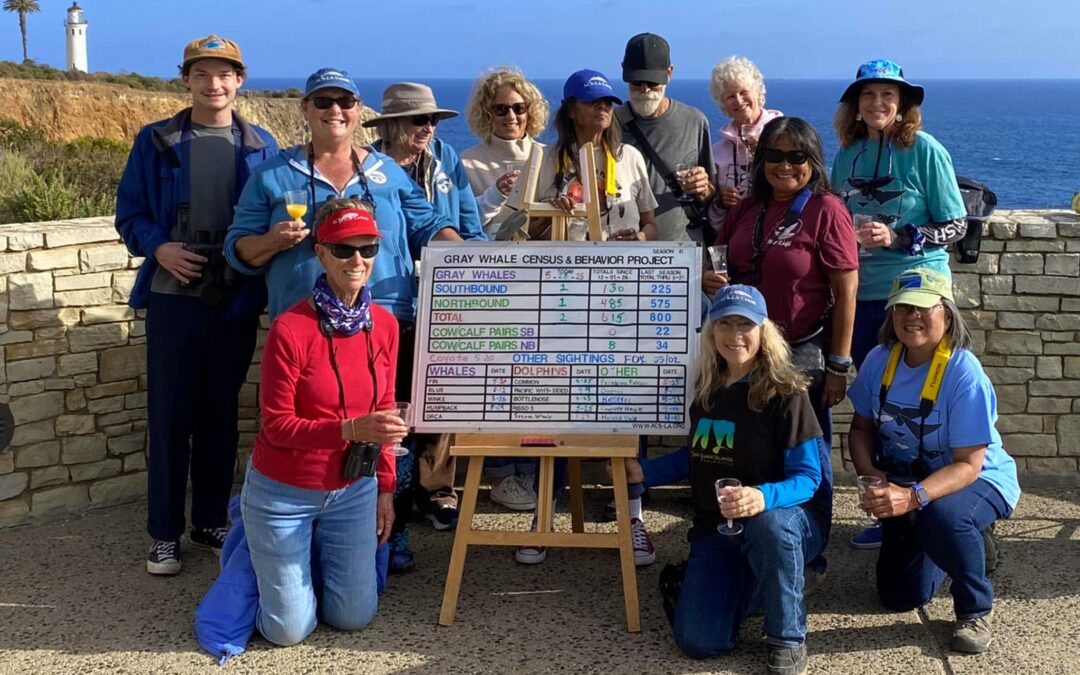
Gray Whale Census Team with our whiteboard displaying our final counts for this season. Clockwise, L to R: Joyce Daniels, Ben Tyrrell, Terri Bidle, Gerrie Teague Cole, Carla Krysiak, Iva Maes, Gregg Gentry, Stacey Patterson, Erlinda Cortez, Kim Hoch, Cynthia Woo, and Census Director Alisa Schulman-Janiger.
This was the 41st season that the American Cetacean Society’s Los Angeles Chapter has sponsored a full season Gray Whale Census and Behavior Project from the Palos Verdes Peninsula, long-term monitoring nearshore gray whales; most grays choose offshore routes here. Our cliff side post is on the Point Vicente Interpretive Center (PVIC) back patio, 137 feet above kelp beds and rocky shoreline; sea floor drops off abruptly near shore. Trained volunteers (citizen scientists) collect data on gray whales and other cetaceans, including identifications, counts, and behaviors. All participants use binoculars with reticles and compass; some use spotting scopes to confirm and detail sightings. We record weather data (visibility, weather conditions, and sea conditions) twice an hour.
Our 2024-2025 Gray Whale Census operated for 173 days, between 1 Dec 2024 – 25 May 2025. Weather conditions such as rain, wind, and fog impacted our counts; we closed for 3 days due to heavy rain and flooding. Observer teams were on duty for 2,013 hours over those 173 days, averaging ~11.6 hours/day; 100 volunteers contributed 8,767 effort hours. Experienced observers anchor all shifts: 12 core volunteers each contributed over 200 hours (totaling 37.2% of our effort hours); 18 other volunteers contributed 100-199 hours (totaling 27.0% of our effort hours). Sadly, we set new record lows for our southbound and northbound gray whale total counts, and for calf counts (including NO southbound calves)! We documented another late southbound migration (perhaps to prolong foraging time in northern feeding areas), and spotted many skinny gray whales. We counted 130 southbound gray whales (NO newborn calves, for the first time ever), and 485 northbound gray whales, including 8 northbound calves (1.6% of northbound migrants), from 1 December 2024 through 25 May 2025. Last season, we counted 225 southbound gray whales, including 22 newborn calves (9.8% of southbound migrants) – and 579 northbound gray whales, including 34 calves (5.9% of northbound migrants). In previous seasons, our southbound counts varied from 293-1,902 and northbound counts varied from 521-3,412. Our gray whale count during the peak southbound week was much lower this season: 28 southbound grays (25-31 January), compared to 68 seen during last season’s peak southbound week. Our highest daily count was 11 southbound grays (on 27 January), a new record low peak southbound count. The crossover period was brief, with few whales going in either direction (a more typical “gap” season), as the migration phase shifted from primarily southbound to primarily northbound. Our official turnaround date was on 21 February, the same as last season. We spotted 14 northbound grays during our southbound migration phase and 33 southbound during our northbound migration phase. Our highest northbound count was on 15 March, with 21 northbound grays, our second lowest peak count; previous northbound peak counts ranged from 20-152. We recorded 96 grays during the peak northbound week (Phase A, main northbound migration pulse) of 15-21 March (154 in 2023-2024), 2 weeks later than last season. We counted 7 northbound grays in our last 4 days; these late season whales may have come from the Gulf of CA, where lots of grays were seen this season – as many headed further south during the cold water La Nina period. We spotted NO gray whales on 50/173 days (51/170 days last season); many of those null days occurred despite excellent sighting conditions. We also documented many other cool marine mammal species, including blue whales, fin whales, humpback whales, minke whales, sperm whales, common dolphins, coastal and offshore bottlenose dolphins, Pacific white-sided dolphins, Risso’s dolphins, California sea lions, harbor seals, and an elephant seal.