ACS-LA Across the Internet
Events
Make a donation
Current Cetacean News
Our ACS-LA Board posts current cetacean news on our Facebook page and the most recent articles can be found on this page. Keep up-to-date by coming back often! And if you are on Facebook, follow us!


American Cetacean Society - Los Angeles Chapter (ACS/LA)
Founded in 1967, the American Cetacean Society protects whales, dolphins, porpoises, and their habitats through public education, research grants, and conservation actions.
No upcoming events
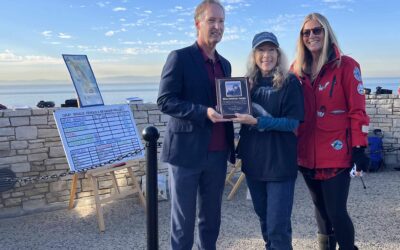
Commemorating 40 Years, Gray Whale Census
On Dec. 1st, 2024, Alisa Schulman-Janiger was recognized for her 40 years of dedication as Director and Coordinator of ACS-LA’s Gray Whale Census and Behavior Project by the Mayor of Rancho Palos Verdes, John Cruikshank. The ACS-LA Board was joined by Census citizen...
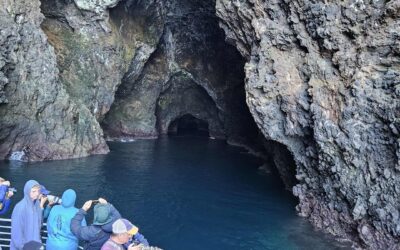
2025 Annual Summertime 8 hour whale watch on the Condor Express
Painted Cave, Santa Cruz Island
Photo credit: Patty Farrell
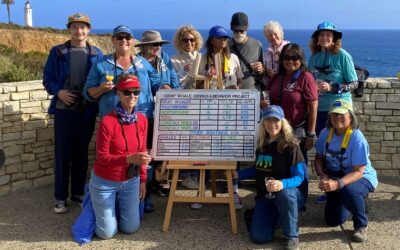
2024-2025 Gray Whale Census Summary
Gray Whale Census Team with our whiteboard displaying our final counts for this season. Clockwise, L to R: Joyce Daniels, Ben Tyrrell, Terri Bidle, Gerrie Teague Cole, Carla Krysiak, Iva Maes, Gregg Gentry, Stacey Patterson, Erlinda Cortez, Kim Hoch, Cynthia Woo, and...
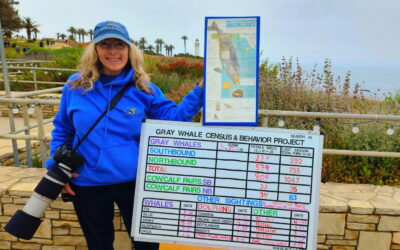
2023-2024 Gray Whale Census Summary
Photo of Alisa Schulman-Janiger at our Gray Whale Census location on the bluffs behind the Palos Verdes Interpretive Center. Photo by Dave Janiger. ACS/LA Gray Whale Census and Behavior Project, 2023-2024 Update: we documented very low gray whale counts, few...
Our Partners and Sponsors



What a day on the water! 🌊🐋
On September 12, ACS-LA welcomed 54 guests aboard the Condor Express for our annual Summertime Whale Watching Adventure in the Santa Barbara Channel. Guests enjoyed a breakfast buffet, beautiful views, and a full day of learning from our wonderful guest naturalists Tamara Mason and Matt Brady.
We had an incredible day of wildlife encounters, including approximately 1,500 short-beaked common dolphins, ~30 long-beaked common dolphins, ~190 offshore bottlenose dolphins, and a humpback whale that we watched for close to 45 minutes off of Gaviota. Through ventral fluke images, this humpback was identified through Happywhale as CRC-16457, with 20 encounters from 2010-2026, between Monterey Bay and Costa Rica! A second distant humpback whale and a small breaching whale (most likely a minke whale), were also spotted. Many of the common dolphins were incredibly active, leaping alongside the boat, bow-riding, and surfing in our wake; the offshore bottlenose dolphins were also very boat friendly. We also spotted a large ocean sunfish, multiple jellyfish, and a wonderful variety of seabirds.
But this trip was about more than an amazing day on the ocean, it also helped support the future of cetacean research. Thanks to everyone who joined us, we raised enough funds to support one ACS-LA research grant in 2027! We are so grateful to our guests, volunteers, crew, and naturalists for helping make this day possible.
A special thank you to our guest naturalists: Tamara Mason, a longtime ACS-LA and Cabrillo Marine Aquarium Whalewatch Naturalist, Gray Whale Census observer, California Naturalist, and member of the Channel Islands Naturalist Corps - and Matt Brady, our avian naturalist with more than 20 years of pelagic birding experience, for sharing their knowledge and helping us appreciate the incredible diversity of life in the Santa Barbara Channel. Thanks also to our resident marine biologist and Gray Whale Census Director Alisa Schulman-Janiger.
Thank you to everyone who came along for the adventure. We hope to see you on the water again soon!
Photos courtesy of Colleen Carroll Alisa Schulman-Janiger Cathy Hachigian
🐋🌊
#americancetaceansociety #acsla #whalewatching #CondorExpress #santabarbarachannel ... See MoreSee Less
1 CommentsComment on Facebook
Identifying Whales at Sea: clues to help you figure out what species you are seeing!
*NOTE: This Australian government publication infographic focuses on whales off Australia and New Zealand. Off California - we see gray whales (not southern right whales).
GRAPHIC: Tony Pyzrakowski.
WEBSITE SOURCE: www.environment.gov.au/marine/marine-species/cetaceans/whale-watching/identification ... See MoreSee Less
1 CommentsComment on Facebook
🐋 **JUST OVER ONE WEEK AWAY!** 🐋
Have you gotten your tickets yet? Join ACS-LA for our Summertime Whale Watching Adventure on Saturday, September 12, from 8:00 AM–4:00 PM!
Approximately one-third of the cetacean species found worldwide can be seen right here in our own backyard—the Santa Barbara Channel. Join us for an unforgettable day at sea!
We'll head out aboard the Condor Express, a jet-powered catamaran custom-built for whale watching. The Santa Barbara Channel is a nutrient-rich environment where steep canyon ridges force cold water to the surface, creating ideal feeding conditions for an incredible diversity of marine life.
Depending on what nature has in store, we could encounter blue whales, humpback whales, fin whales, minke whales, and a variety of dolphins, including common, bottlenose, Pacific white-sided, Risso's, and northern right whale dolphins, as well as Dall's porpoises. We'll also be keeping an eye out for California sea lions, harbor seals, elephant seals, and a large variety of seabirds!
☕ Your ticket includes a delicious continental breakfast served onboard.
🔬 Best of all, all net proceeds from this trip will be used to fund ACS-LA's 2027 Research Grant!
Meet Our Guest Naturalists!
We are very happy to welcome back **Tamara Mason**! Tamara is a returning guest naturalist who has volunteered with ACS-LA and Cabrillo Marine Aquarium for over 10 years as part of their Whale Watch Naturalist Program. Tamara is a certified California Naturalist, and also volunteers with California State Parks. She has also been an observer for our Gray Whale Census and Behavior Project for 7 seasons. She is a member of the Channel Islands Naturalist Corps (CINC), a group of volunteer naturalists trained with the Channel Islands National Marine Sanctuary, part of NOAA, and Channel Islands National Park. During our trip aboard the *Condor Express*, she will be sharing information about the especially unique part of the Santa Barbara Channel we will be exploring. In addition, Tamara is a Naturalist with Cabrillo Whalewatch, sponsored by ACS-LA and Cabrillo Marine Aquarium, as well as a Naturalist with ACS-OC. She has volunteered with the ACS-LA Gray Whale Census and Behavior Project and FLOW, a citizen science project that monitors ocean water quality near Huntington State Beach and Bolsa Chica. Tamara is also a former board member of ACS-LA, the Los Angeles Mycological Society, and the Long Beach City College Foundation–Fine Arts Association. She is looking forward to seeing everyone aboard the *Condor Express* in the Santa Barbara Channel!
We are also very happy to welcome back **Matt Brady** as our Avian Naturalist! Matt has been pelagic birding for over 20 years. With the warm water we have been experiencing, there have been a number of interesting birds in the area, and Matt is eager to see what's out there and help us spot them! As an undergraduate at UC Santa Cruz, Matt learned the ropes in Monterey Bay and has since participated in dozens of pelagic trips throughout northern and central California. After earning a master's degree at Louisiana State University, Matt now resides in Ventura, where he has been exploring the waters of the Southern California Bight. When he isn't at sea, Matt enjoys birding coastal hotspots and desert oases.
There will also be cetacean experts and enthusiasts onboard to share their knowledge and help us learn more about the incredible marine mammals and wildlife we encounter throughout the day.
The Condor Express provides a comfortable and exceptionally smooth ride, with walk-around decks, a huge upper sun deck, a raised forward bow area, and plenty of opportunities to take in the incredible views and wildlife.
🐋 Come for the whales. Support cetacean research. Spend an unforgettable day at sea with ACS-LA!
Don't miss the boat—get your tickets today!
www.eventbrite.com/e/acs-la-summertime-whale-watching-adventure-2026-tickets-1989611415302?aff=od... ... See MoreSee Less
0 CommentsComment on Facebook
Fascinating look at dolphin fetal folds and hairy beaks! This very young bottlenose dolphin calf stranded (unknown cause) in July in South Carolina, and did not survive. The stranding response team shared this excellent post, which provides a close look at - and brief explanation for - fetal folds and for the hairs (vibrissae) found on the calf's beak: normal newborn characteristics. This very sad event provides a good educational opportunity; well-done! ... See MoreSee Less
This content isn't available right now
When this happens, it's usually because the owner only shared it with a small group of people, changed who can see it or it's been deleted.2 CommentsComment on Facebook
ORCA ALERT: Eastern Tropical Pacific killer whales: about 12, headed south off Mission Bay today! Several whale watching vessels spent hours with a large group of orcas, including at least several well-known whales: Baja Nicki and her young calf, adult female Ana, and young male Diego. We documented a group of 10 (2 subgroups of 5) of these whales on at least 21 days between December 11, 2023 and February 3, 2024, between San Diego and the Santa Barbara Channel - predating on common dolphins and bottlenose dolphins (both offshore and coastal). Sadly, on January 2, 2024, they attacked and killed our first southbound gray whale calf January 2 off our ACS/LA Gray Whale Census and Behavior Project at Point Vicente - our only documented southbound gray whale calf predation in all 42 seasons. They have also harassed fin whales; we have never seen them attack sea lions.We last documented them off southern California in mid-October 2025. NOTE: these orcas can be VERY boat friendly; they often bow ride and approach boats - if you encounter them, PLEASE BE RESPECTFUL: and do not chase them or interfere with foraging activities! Welcome back, beautiful orcas! (Summary by ACS/LA Gray Whale Census Director, who is also California Killer Whale Project's Lead Research Biologist: Alisa Schulman-Janiger). ... See MoreSee Less
This content isn't available right now
When this happens, it's usually because the owner only shared it with a small group of people, changed who can see it or it's been deleted.1 CommentsComment on Facebook
Thar she blows! Nice graphic (from the SOUTHERN hemisphere) demonstrates how shapes of a whale's blow and head are big clues to help identify the whale species you are watching; seeing the back will help even more. Illustration by Tony Pyrzakowski, modified from "Whales and Dolphins of New Zealand and Australia: An Identification Guide", by Alan N. Baker (repost, by request).
NOTE: Southern hemisphere has southern right whales, but no gray whales - so gray whales are not included in this graphic. ... See MoreSee Less
15 CommentsComment on Facebook