
ACS/LA GRAY WHALE CENSUS AND BEHAVIOR PROJECT SUMMARY: 2025-2026
By Gray Whale Census Project Director/Coordinator Alisa Schulman-Janiger
Email: janiger@cox.net
Daily sighting details during Gray Whale Census season: https://www.facebook.com/acs.lachapter; www.acs-la.org
Our northbound count set a new record low, our southbound count rose (second lowest on record), calf counts rose, we had another late southbound migration and a very early northbound migration (likely to prolong foraging time in northern feeding areas), we spotted many skinny gray whales (but fewer than last season), and we watched more humpback, fin, blue, and minke whales and Pacific white-sided dolphins during our 2025-2026 ACS/LA Gray Whale Census and Behavior Project. This is the 42nd season that American Cetacean Society's Los Angeles Chapter has sponsored a full-season gray whale census project from the Palos Verdes Peninsula since 1 Jan 1984; all consecutive seasons (except for COVID-19 closures 21 Mar 2020-25 May 2020, and our entire 2020- 2021 season). Our cliff-side post is on the Point Vicente Interpretive Center (PVIC) patio, 138 feet above kelp beds and rocky shoreline, with a seafloor that drops off abruptly nearshore. Citizen scientists (trained volunteers) collect data on gray whales and other cetaceans, including identifications, counts, and behaviors. All participants use binoculars with compass and reticles; some also use spotting scopes to confirm/detail sightings. Weather data (visibility, weather conditions, and sea conditions) are recorded at least twice hourly.
CENSUS STATION COVERAGE
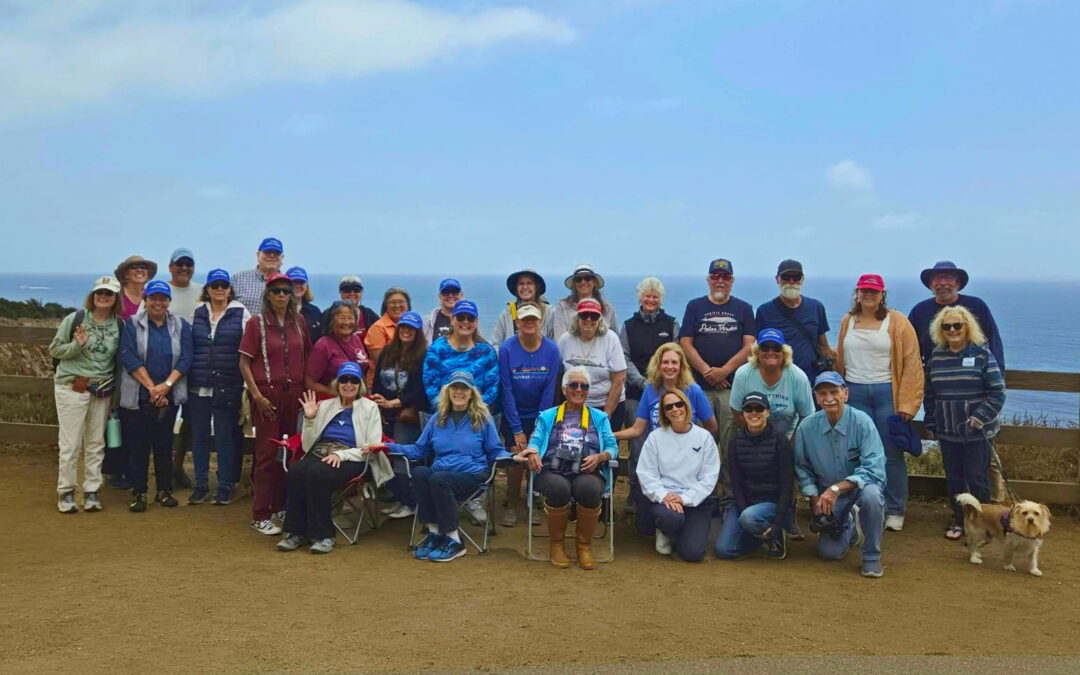
Our census station ran for 2,008 hours over 171 days from 1 Dec 2025 to 25 May 2026, averaging 11.7 hours/day; we were closed for 5 days due to heavy rain and/or high winds. Our 105 volunteers contributed 10,200 effort hours. The thirteen core volunteers that donated over 200 hours each, totaling 36.1% of effort hours (and their number of observer days) include: Joanne Kajiyama, 582 (140); Alisa Schulman-Janiger, 348 (85); Stacey Patterson, 319 (77); Carla Gagne, 293 (46); Kathy Beckman, 278 (44); Chad Sprouse, 261 (56); Cheryl DeMatteis, 259 (41); Stacie Kortkamp, 252 (44); M’Liz Callender, 245 (75); Stewart Warren, 222 (42); Joyce Daniels, 217 (44); Lisa Falk, 207 (48); and Kimberley Hoch, 203 (45). Nineteen other volunteers contributed 100-199 hours (totaling 25.2% of our effort hours). Experienced observers anchor all shifts; 40 volunteers have been with us for at least ten seasons!
GRAY WHALE COUNTS
northbound counts hit a record low, southbound count rose (second lowest count ever). We spotted 214 southbound and 445 northbound gray whales (130 southbound and 485 northbound grays in 2024-2025): this set a new record low northbound count. We did not see any gray whales on a record 53/171 days (saw no grays on 50/173 days last season). Gray whale counts have widely fluctuated over 41 previous seasons: southbound counts varied from 292-1,902, and northbound counts varied from 521-3,412. Although most of the ~17,750 Eastern North Pacific gray whales (NOAA Fisheries 2025-2026 estimate) migrate past California, we spot only a small proportion. Gray whales off Palos Verdes (especially adults) tend to travel further offshore - notably during the southbound migration. Northbound whales (especially cow/calf pairs and juveniles) tend to hug the coastline. These trends, combined with extended springtime observation hours, contribute to our higher northbound counts. Shifting migratory corridors and weather conditions result in annually fluctuating shore-based counts. The number of whales completing migration varies; feeding ground conditions (especially ice coverage) affect migratory timing and corridors. Poor visibility drastically affects counts; fog compromised visibility during portions of fewer days this season (54/171), compared to 2024-2025 (85/173).
PEAKS AND TURN-AROUND DATES
later southbound migration; earlier northbound migration, higher peaks. Our peak southbound count was 17 on 23 Jan (11 last season, a record low); previous peak counts ranged from 15-98. We spotted 61 southbound whales during peak southbound week of 19-25 Jan (28 in 2024-2025), a week earlier than last season. The official turn-around date (daily northbound whales exceed southbound whales) was on 9 Feb, 12 days earlier than the past two seasons. We spotted 13 northbound grays during the “southbound migration”, and 62 southbound grays during the “northbound migration”. Our peak northbound daily count was 30, on 5 Mar; previous northbound peak daily counts ranged from 20-152. We recorded 99 grays during the peak northbound week (Phase A, main northbound migration pulse) of 28 Feb-6 Mar (154 in 2024-2025), 2 weeks earlier than last season.
HIGHER CALF COUNTS!
We spotted 17 southbound calves (1.6% of the southbound migration) between 22 Dec-28 Feb; none seen last season – for the first time ever! Our record high southbound calf count occurred during the 1997-1998 season (106 calves, 8.6% of southbound migrants). Previous southbound calf counts ranged from 3-60 (0.5%-8.9% of southbound migrants), with the lowest percentage (0.5%) in 1988-1989. We counted 16 northbound calves (3.6% of northbound migrants) between 28 Mar-21 May, peaking with 3 calves on 15 Apr; in 2024-2025, we spotted 8 northbound calves (1.6% of northbound migrants). In 2015-2016, we tracked a record 341 northbound calves (13.4% of northbound migrants). Our other calf counts ranged from 11-318 (0.9%-22.9% of northbound migrants). We recorded 3 cow/calf pairs during the peak week of 15-21 Apr, 1 week earlier than last season (3 pairs in 2024-2025). The peak northbound week (Phase B, cow/calf migration pulse) typically occurs 4-8 weeks later than the main pulse; this enables calves to nurse longer and strengthen swimming skills in Baja lagoons before initiating their perilous migration northward.
GRAY WHALE BEHAVIORS, HUMAN INTERACTIONS (boats, entanglements)
BEHAVIORS: mill, roll, breach, head lift, bubble blast, feeding (sand/mud in the mouth), nursing, courtship/mating. Whales joined, split.
HARRASSMENT (boats, jet skis (14), 10 encounters in 10 days: approaching whales too fast or too closely!
Whales’ reactions: sailboat approached, whale went low profile; 2 private boats too close, went low profile; small boat crossed path, trio turned out; lobster boat moved as whale surfaced near, not seen again; small boat approached, pair dove 23 minutes; dredger passed close, pair not seen again; dive boat ran over fluke prints, whale dove longer; fishing boat crossed path, whale breached 3 times; boat and 3 jet skis in whale’s path, whale dove 11 minutes; small boat quickly approached, whale turned offshore.
ENTANGLED HUMPBACK WHALE
same whale on 2 days (confirmed by offsite drones)!
20 Jan: headed north, 1 mile off; covered with gill net, lines, small floats, 2 larger yellow floats.
Alisa alerted the NOAA Fisheries Entanglement Response Team; too late in the day to launch a response.
13 Feb: same whale, headed south, 1 mile off. Alisa alerted NOAA Fisheries Entanglement Response Team; boats could not relocate.
*To report entanglements: call NOAA’s Entanglement Reporting Hotline: (877) SOS-WHALe, (877) 767-9425
PHOTO-ID MATCHES!
*10 Pacific Coast Feeding Group (PCFG) grays matched our Gray Whale Census images!
Another matched to gray whale seen off San Diego. PCFG population ~200-250 grays), via researcher Mark Sawyer (The Whales of Clayoquot & Barkley), OSU’s GEMM Lab. Matched whales included: Pattern, Rocket, Colonel, Crosshatch (with her new calf), Scarback (famous adult, huge wound on her back, we have seen her several years), Salt, Pepper, Blade, Thorny, and Jupiter. *1 Western North Pacific gray whale match! Via researcher Olga Sychenko (Russian Gray Whale Project); <300 gray whales
MANY SKINNY GRAYS
we again documented many skinny gray whales: at least 61 whales (9.3% of all grays whose body conditions we could access). Last season, we spotted a record number of at least 84 skinny gray whales (13.7% of all grays with accessible body conditions) - compared to at least 31 skinny grays the previous season (3.9% of those with accessible body conditions). NOAA Fisheries closed the 2019-2023 Gray Whale Unusual Mortality Event (UME) in Nov. 2023: during that period, 690+ grays stranded, many skinny whales, low calf counts. Grays are still in crisis: many strandings, skinny whales, low calf counts. NOAA Fisheries 2025-2026 Eastern North Pacific population estimate dropped to ~17,750 in 2025-2026, more than 30% decrease from the 2015-2016 estimate of nearly 27,000 (a record high) - but up from last season’s estimate of ~12,950. PRELIMINARY CAUSE OF THE LAST 3 UMEs: reduced sea ice coverage and available benthic prey led to poor body condition. Changes to Arctic feeding areas (increased temperatures, less ice coverage, lower nutrient flow) caused gray whale populations to boom and bust, based on shifting access to mud-dwelling, shrimp-like amphipods (primary prey), and available prey quality. Gray whales may shift farther north: Arctic warming leads to a northward shift in amphipod distribution, which thrives in cooler water - feeding on algae falling from ice sheets. Grays may also switch to primarily feeding on pelagic krill swarms rather than benthic amphipods; their documented prey includes 100+ species. Previous large-scale UME population fluctuations were relatively short-term events followed by population recovery. Climate change could limit how many gray whales can survive in the future; their population may cap at a lower level, and fewer may complete their migration to breeding lagoons in Baja CA.
OTHER SPECIES SIGHTED
We spotted 11 other marine mammal species during our 171 observation days. This included more days with humpback, fin, blue, and minke whales and Pacific white-sided dolphins, as well as multiple sperm whales and orcas! Comparing this season (to 2024-2025, with 173 open days; range indicates confirmed IDs-likely IDs): we spotted common dolphins on 149 days (144), bottlenose dolphins on 142 days (153), fin whales on 77-92 days (52-68), humpback whales on 71-77 days (27-31); Pacific white-sided dolphins on 22-23 days (5), blue whales on 7-16 days (4-5), minke whales on 7-16 days (2-5), sperm whales on 3 days (3), killer whales on 1 day (0), California sea lions on at least 148 days (163+), harbor seals on at least 45 days (21+), and a possible southern sea otter on 0-1 day (0). *BIGG’S KILLER WHALES, 9 Dec 2025: Alisa identified them as the 4 CA51s, aka “The Friendly Pod”!* PAST SEASONS: other species sighted included Bryde’s whales or sei whales, Risso’s dolphins, false killer whales, pilot whales, northern right whale dolphins, Dall's porpoises, beaked whales, Steller (northern) sea lions, and northern elephant seals.
INTERACTIONS
we documented gray whales with bottlenose dolphins and Pacific white-sided dolphins; humpback whales with fin whales; humpback whales and fin whales with common dolphins; humpback whales with sea lions; bottlenose dolphins with sea lions. MISC: Peregrine falcons* on 122 days (they nest at Point Vicente), ospreys* on 57 days (foraging), and an immature bald eagle on 8 days.
*NOTE: peregrine falcons, ospreys, and bald eagles continue to recover from DDT (pesticide) contamination.*
OBSERVERS' EFFORT HOURS 10+ hours/season (*new observers)
Joanne Kajiyama (582), Census Project Director/Coordinator Alisa Schulman-Janiger (348), Stacey Patterson (319), Carla Gagne (293), Kathy Beckman (278), Chad Sprouse (261), Cheryl DeMatteis (259), Stacie Kortkamp (252), M’Liz Callender (245), Stewart Warren (222), Joyce Daniels (217), Lisa Falk (207), Kimberley Hoch (203), Kathy Wanchek (178), Petrina Long (168), Gail Goulet (165), Mike Malone (160), Cynthia Woo (152), *Catherine Mone (145), Iva Maes (144), Monica Capalia (142), Kathy Hill (141), Nina Whiddon (133), Dee Whitehurst (130), Laurie Thomson (130), Sjors (129), Rachel Friedman Narr (123), *Lauren Boyer (113), Rose Piccioni (107), Kevin Coy (106), Nancy Johnson (106), Cheryl Beshke (102), Terri Bidle (100), Bart Eccles (99), Miriam Moses (99), Pat Ashenfelter (94), Melody Baylor (93), Theresa Stahlman-West (92), Kim Watson Young (91), *Katie Underwood (86), Stacy Gremminger (82), Cheryl Revkin (82), Jean Woodrow (80), Andrew Holmes (79), Tamara Mason (79), *Emily Trendle (77), Gregg Gentry (76), Chris Kern (72), Lilia Stephenson (72), *Teresa Palos (71), Stephanie Bryan (70), Patty Miller (70), Cathy Ragland (70), Pat Harpole (69), Ken Ragland (66), *Hillary Black (64), Gerrie Teague Cole (63), *Erini Galatis (62), Jean Huber (63), Erlinda Cortez (61), Gordon Gates (61), Sheila Parker (61), Ben Tyrrell (61), Rob Gray (60), Vikki Franck (59), *Mike Maracci (58), Lin Penrose (57), *Vickie Poponi (56), Kathy Eddy (55), Val Lattanza (55), *Leanna Levine (53), *Julia Stein (52), Robin Riggs (51), Nancy DeLong (50), Eric Hemion (50), *Elizabeth Sala (50), Cesar Castaneda (48), *Susie Hattabach (47), Denise Donegan (46), Peter Rej (46), Ella Goodheart (44), Joan Krause (43), Donna McLaughlin (42), Paul Nitchman (42), Noelle Pellowski (42), *Beth Woodruff (42), *Lee Bergeron (41), Debi Chew (40), Christy Varni (40), Lisa Stumph (40), Patricia VanOver Indictor (38), Kim Botts (34), Stan Kaminski (33), Nina Sua (31), *Masy Domecillo (28), Gina Lumbruno (28), Nancy Arseneault (27), Deborah Leon (27), Ann Pitts (26), Maria Coy (25), Nanette Dominguez (25), Julian Ponce (22), Shelly Conger (21), Patty Farrell (21), and *Omar Salah (13).
SPECIAL THANKS
anchor Joyce Daniels (generates graphs), Dave Janiger (digitizes data), the Pt. Vicente Interpretive Center!*
INTERESTED IN JOINING US: “The People Who Count”? Please contact Alisa Schulman-Janiger at: janiger@cox.net
Gray Whale Census volunteers needed from 1 Dec-25 May, no experience necessary, on-site training in December!
**This data is copyright-protected. Please contact Census Project Director for permission to cite in publications: janiger@cox.net